|
|
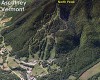
At 3,150 feet in elevation. Mt. Ascutney towers over the Connecticut River Valley along the border of Vermont and New Hampshire. Originally starting as a small, community area, multiple attempts were made to develop it into a large resort, eventually ending an extended closure starting in 2010. Ascutney returned to its roots in 2016, when it was reborn as a community area.
Early Skiing on Mt. Ascutney
Organized skiing on Mt. Ascutney dates back to at least the winter of 1935-36, when the CCC and Windsor Outing Club opened the Mt. Ascutney Trail. At 5,400 feet in length, this intermediate trail immediately captured the interest of skiers throughout the region, as did the nearly completed Ascutney auto road nearby.
A group of people including Catharine "Kip" Cushman, Bob Bishop, Dick Springer, Bob Ely, Robert Hammond, and Dr. Peter Patch worked together to get lift served skiing on Mt. Ascutney in 1946. Composed of tiered rope tows, two slopes, and a few trails, the Mt. Ascutney Slopes development was likely located at the present day bottom of the Brownsville Trail on Route 44. The ski area was considered a success, drawing crowds of 800 during the Christmas-New Year's holiday week in 1946-47.
Mt. Ascutney Proper Opens
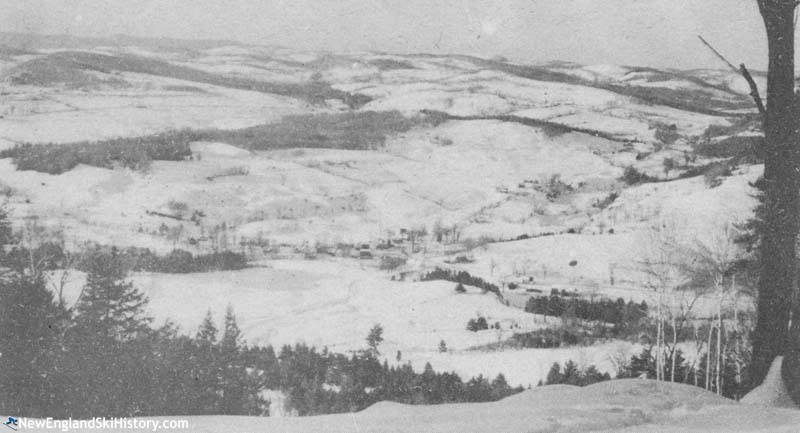
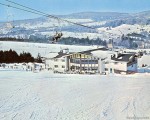
The 'Expert Slope' circa the 1940s or 1950s |
For 1947-48, the rope tow operation was relocated west to the present location of Mt. Ascutney Resort. The improved operation included diesel rope tows, many new trails, night skiing, and snowcat served skiing (via a 3.5 mile ride in a Tucker machine on the other side of the mountain).
Another rope tow was added for the 1948-49 season. Poor snowfall resulted in a changing of the board.
After another poor season in 1949-50, Ascutney found itself in bankruptcy for the first time. Cushman's brother, Percival Ranney, purchased the area and handed it back over to Kip. Mickey Cochran was reportedly hired as General Manager for the 1950-51 season, which was also poor. Though Cochran subsequently took a job teaching high school, he and his family continued to ski at Ascutney for much of the decade before heading north and starting their own ski area. Cochran's children later racked up National, World Cup, and Olympic victories.
In 1955, George Dunning took over as manager of Ascutney for a season. Following 1955-56, Dunning apparently headed over to New Hampshire and attempted to open Ragged Mountain. In the fall of 1956, Ascutney was sold to John Howland, president of Windsor Machine Products, for a reported $2,000.
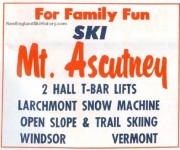
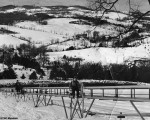
Following a successful 1956-57 season, Howland announced plans to expand the ski area. Mt. Ascutney Ski Area, Inc. was formed by Howland, with Walter Paine becoming the first outside shareholder. The capital injection funded significant improvements for the 1957-58 season, including a 2,250 foot T-Bar and Larchmont snowmaking equipment, the latter billed as the first in Vermont. Other improvements included an expanded base lodge and a new trail. Though the season got off to an uneven start, it reportedly extended into April.
A rope tow was reportedly installed for the 1958-59 season.
For 1959-60, the novice area was improved with snowmaking and chairlift service. Operating on a track, the Larchmont lift was plagued with mechanical problems. After being marketed for the 1960-61 season, the lift quietly removed.
After narrowly avoiding bankruptcy, West Slope Area was developed for the 1962-63 season, served by a new T-Bar. Also around this time, Walter Paine (publisher of The Valley News), became principal owner in the ski area, keeping John Howland on as General Manager.
Ascutney's First Real Chairlift Debuts
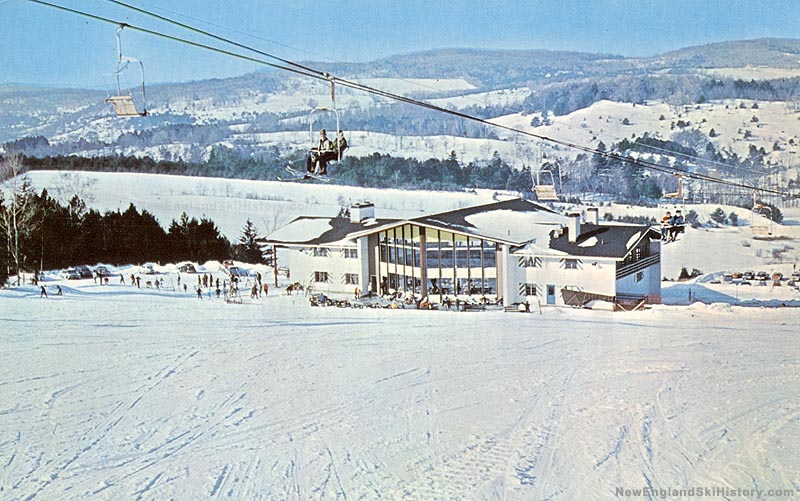
The base lodge circa the 1960s |
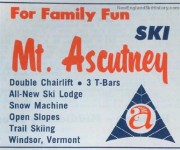
Ascutney moved into the big leagues in 1963-64 when it expanded upward with a new Hall double chairlift, increasing the area's vertical drop from 620 to 1,470 feet. In addition, a novice T-Bar was added and a new lodge built. Meanwhile, construction of Interstate 91 was approaching the Ascutney region.
Ascutney was chosen as the site of the 1964 NCAA Championships, when Dartmouth Skiway lacked natural snow. Though the course was set on March 4, 1964, overnight rains took out so much snow that only 10 of 55 gates remained standing, resulting in the cancelation of the race.
Fred Bocks took over as general manager for the 1965-66 season, as a new dining room and bar were introduced at the base lodge. Jon Putnam was named ski school director, quickly making national headlines with innovative videotaped instruction. Lee Cahbot took over was ski school director in 1966 when Putnam departed to the new Loon Mountain ski area.
Constantly in the red, circa 1967 the ownership hired New York's Kissing Bridge to manage Ascutney. Bob Paron is dispatched to Vermont to serve as General Manager, reportedly with the goal of making the area profitable so that it could be sold.
For 1968-69, night skiing was expanded and a mid station added to the double chairlift, allowing for novices and intermediates to access easier terrain. In addition, the Novice T-Bar was relocated to a new slope between the double chairlift and Main T-Bar. At this point, snowmaking did not extend above the mid station.
A major real estate project was launched in 1969, which was supposed to result in 200 year round vacations homes being constructed. Called Sky Hawk, the development was headed by Hawk Mountain Corporation.
To address Ascutney's reputation as not having enough novice terrain, for the 1970-71 season the Sunrise Mountain area was constructed, featuring novice and intermediate terrain serviced by a new Hall double chairlift. Management also debuted an interchangeable season pass, valid at Ascutney and its other New England ski area, Jiminy Peak.
Ownership Changes
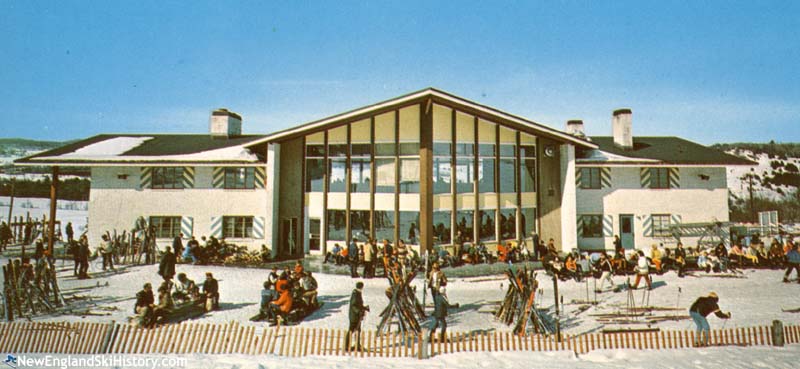
The base lodge circa the 1960s |
In September of 1972, the announcement came out that Walter Paine had sold the 820 acre ski area to a group led by John and Sarah Giles. The timing wasn't great for the new ownership, however, as a January 1973 thaw and a rough 1973-74 left the New England ski industry in bad shape. General Manager Bob Paron departed for Bromley following the 1972-73 season. By March of 1974, Ascutney was "mortgaged to the hilt," according to Assistant Manager Bob Straw.
Apart from some real estate development, Ascutney ski area did not change much during the 1970s. After yet another rough winter, including an extended February closure, the Giles sold the ski area to Dr. Ronald Massa in July of 1981 for an estimated $1.35 million.
The subsequent seasons proved to be difficult as well. In March of 1983, The Mt. Ascutney Ski Area Corp. filed for Chapter 11 bankruptcy, with some $2 million of debt (as compared to $2.5 million of listed assets).
Massive Growth
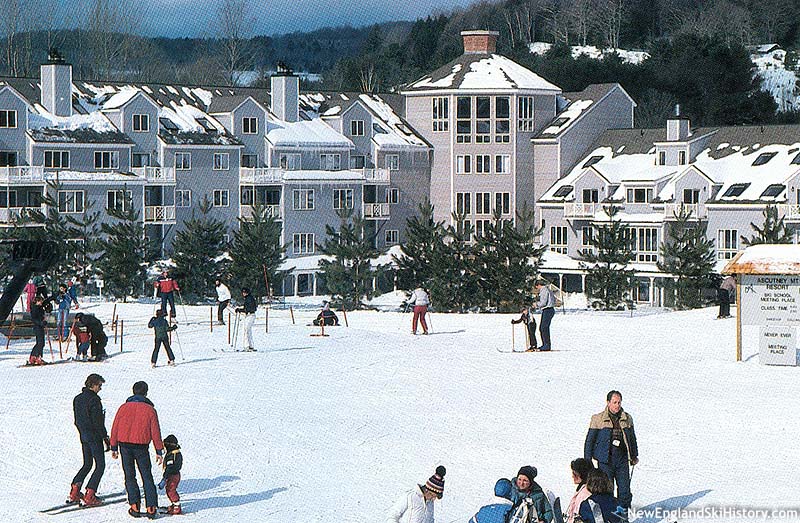
The Village Area in the 1980s |
In the summer of 1983, a group named Summit Ventures, Inc. purchased Ascutney for an estimated $1.5 million and began an aggressive 10 year investment plan. The main shareholders included Joseph Grano Jr., Lou Guido, Daniel Tully, and Ira Lampert.
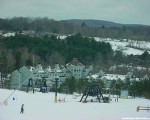
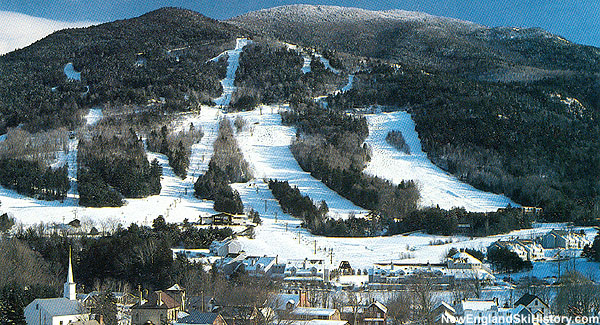
In conjunction with the development of 100 condos, big changes took place on the ski area in 1984-85. Two new triple chairlifts were installed, expanding the ski area downward to the new Village Area. In addition, significant investments were made in snowmaking and grooming.
Former general manager Bob Paron passed away on August 7, 1986 at the age of 56.
For 1986-87, the summit double chairlift was upgraded to a triple, giving Ascutney a top to bottom modern lift system. In October of 1986, the Tax Reform Act of 1986 was signed, resulting in a change in deductions for real estate investments. According to the ownership, this started a downward spiral. The rough 1988-89 winter did not help, as a snow drought became so desperate that Ascutney brought in members of the Abenaki Nation to perform a snow dance.
Bankruptcy and Closure
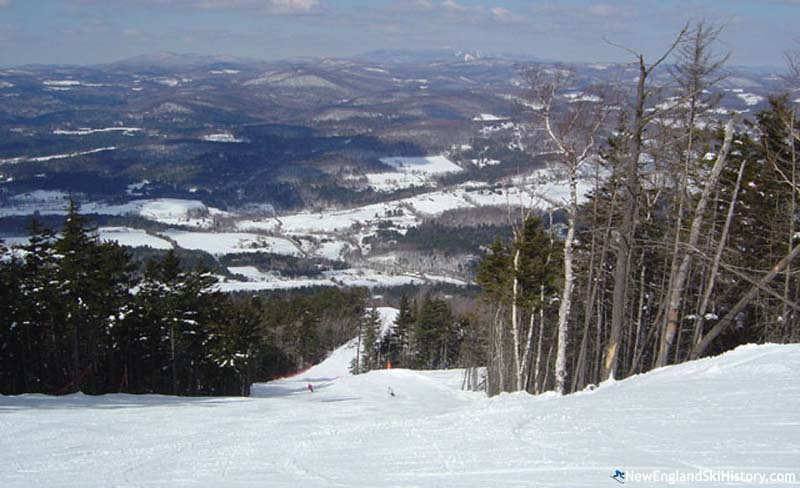
The Gateway trail (2005) |
By the end of the decade, some $65 million had been invested in Ascutney. With debts mounting, Ascutney filed for bankruptcy protection in April of 1990. While the area was able to operate during 1990-91, creditors forced it into liquidation that spring.
By the end of 1991, wounds were only getting worse. The town of West Windsor was owed $350,000 in back taxes, accounting for near a year's budget. Details of lavish expense accounts also emerged, such as nearly a half million dollars spent on travel and entertainment (including private jet use) by ownership during the late 1980s.
Reopening and Expansion
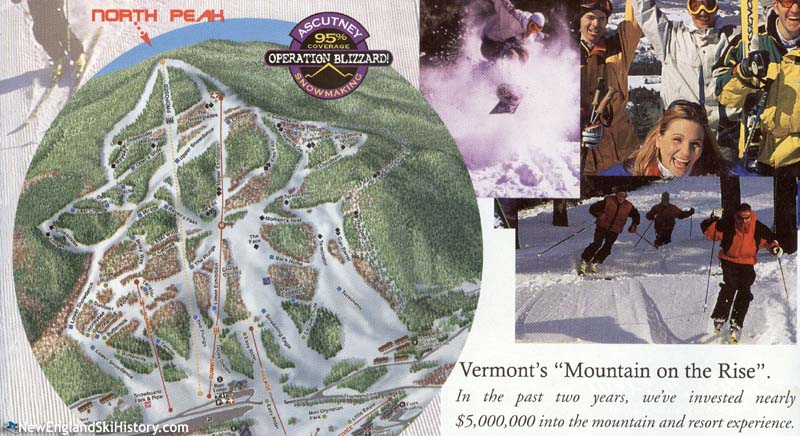
1990s Ascutney Expansion Advertising |
In June of 1993, Steve and Susan Plausteiner purchased Ascutney at auction for $1.1 million, beating the owners of Smugglers Notch and an equipment liquidator. Ascutney reopened in December of 1993.
A five year investment plan started in the middle of the decade with an initial focus on snowmaking and base facility improvements. Also around that time, the Plausteiners attempted to go public with their Snowdance company. With some of the $13 million in funds they hoped to raise, the Plausteiners hoped to purchase and reopen Hogback in southern Vermont. The IPO was dropped circa 1998.
In 2000, $3 million was invested, including a new high speed detachable quad. Capping the five year expansion campaign, the new North Peak development resulted in nearly 300 more vertical feet of terrain above the top of the triple chairlift. Unfortunately, debt was growing.
Former owner John Howland passed away on December 19, 2003 at the age of 88.
Closure
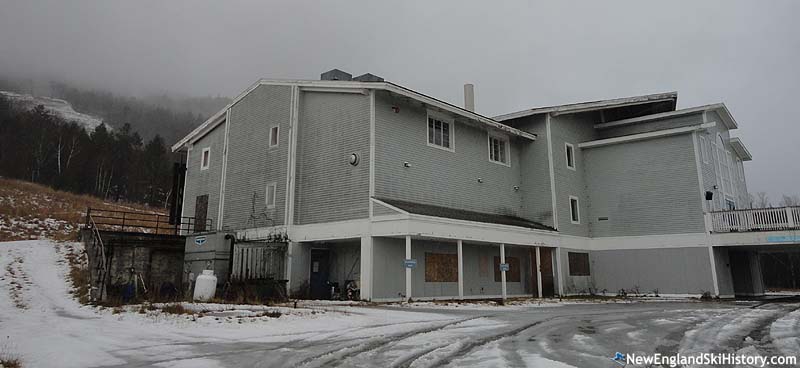
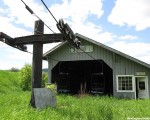
The abandoned base lodge (2012) |
By 2008, Dan Purjes' MFW Associates was commencing foreclosure proceedings on the ski area, citing $1.86 million in debt and $917 per day in interest charges. Two years later, the Plausteiners sold their share in Ascutney to Purjes, who then unsuccessfully attempted to liquidate the area that summer. That fall, word spread that Ascutney would not operate in 2010-2011.
In early 2011, Burke looked to have a $1.55 million deal in place to purchase the high speed quad. Removal costs resulted in Burke backing out and instead purchasing a brand new lift.
In early 2012, Crotched Mountain, NH announced it had purchased the high speed quad. The refurbished lift debuted as the "Crotched Rocket" in December of 2012. Meanwhile, the fixed grip chairlifts remained standing at Ascutney.
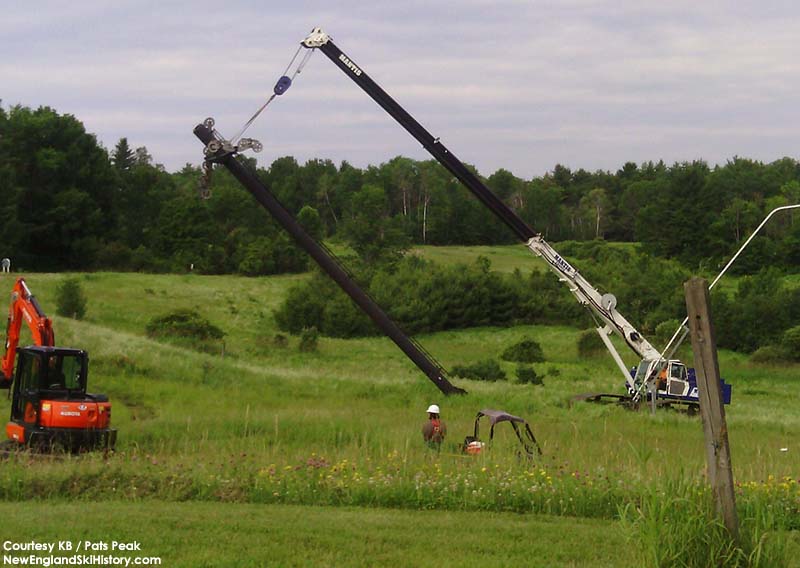
Removal of the lower mountain chairlifts (2014) |
The area was reportedly auctioned to MFW Associates for $1.5 million in early November 2013. While the title was reportedly free and clear, the area remained idle for a fourth consecutive season during the winter of 2013-2014.
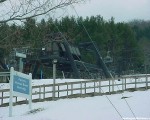
Though MFW Associates had initially hoped to reopen the ski area, it was unable to find a financially viable plan. Instead, the triple chairlifts were sold to Pats Peak and removed during the spring and summer of 2014.
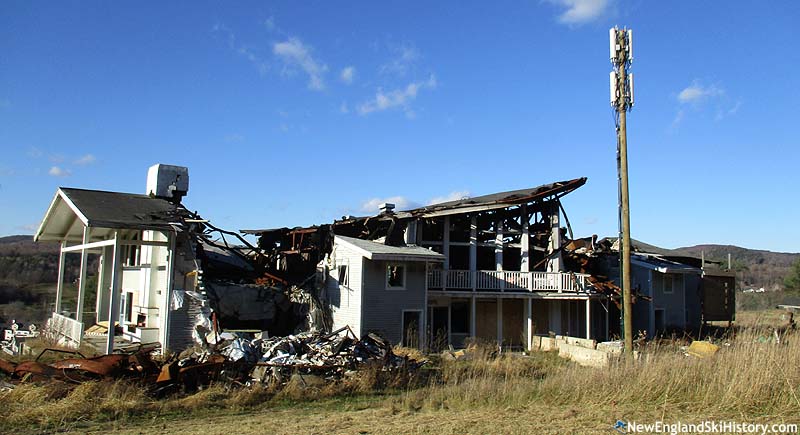
The remains of the burned base lodge (2015) |
On October 14, 2014, West Windsor voters approved the purchase of 469 acres of Ascutney, as well as the former base lodge. The lodge was destroyed by a fire on January 8, 2015.
Mount Ascutney Outdoors
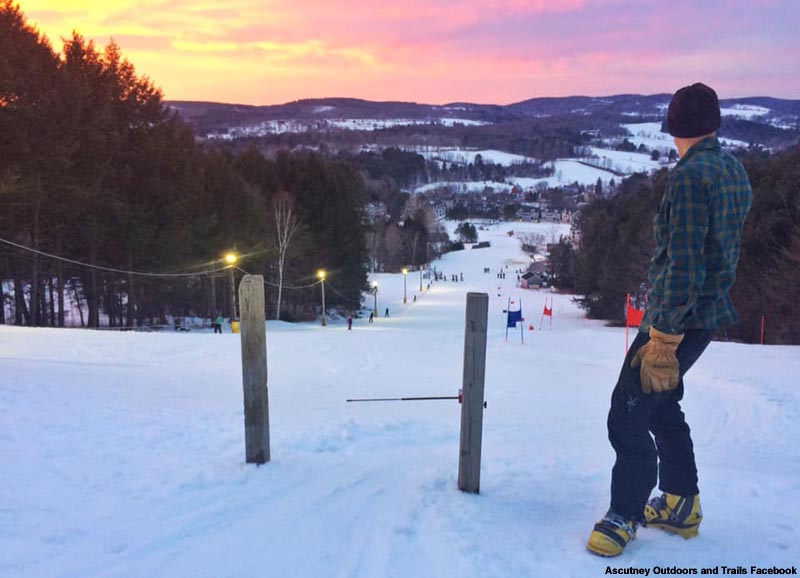
Night racing (2019) |
A non-profit named Mount Ascutney Outdoors emerged in 2015 with plans to reopen the ski area. In late 2015, the Town of West Windsor acquired the bulk of the ski area with Upper Valley Land Trust holding a conservation easement. As a result of the agreement, lift service could not be restored to the upper mountain.
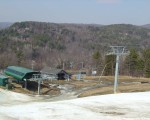
On January 16, 2016, Mount Ascutney Outdoors opened a rope tow on the lower mountain. In 2017, a T-Bar was purchased and a fundraiser established to generate funds for installation. A new base lodge was dedicated in the fall of 2018, while lift served snow tubing debuted in January.
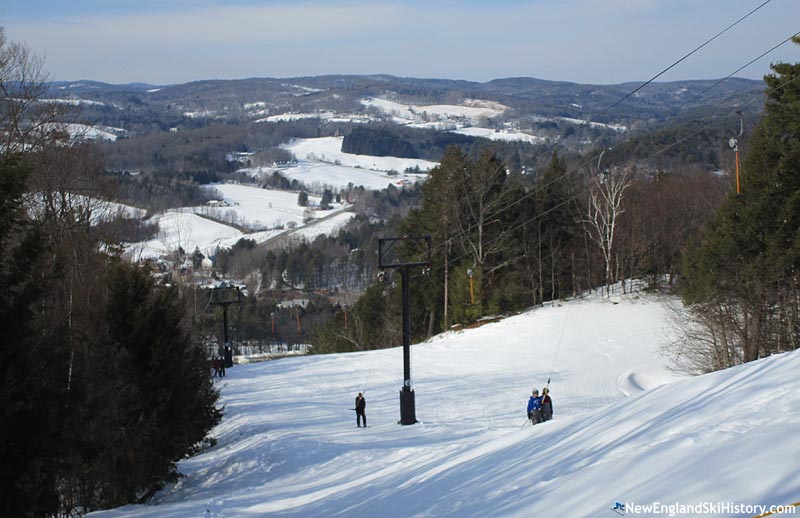
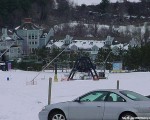
The T-Bar (2020) |
The new T-Bar debuted in February 2020, restoring lift service to the lower portion of the mountain and expanding the vertical drop from 170 to 435 feet. Portions of the upper mountain have been retained for backcountry skiing.
NewEnglandSkiConditions.com Reports
| Month |
Average Percent of Terrain Open |
| February | 98% (5 reports) |  |
|
| Recent Conditions Reports |
 | Feb. 11, 2023 by alpinevillagepres
Frozen Granular, Ice |
 | Feb. 5, 2022 by alpinevillagepres
Packed Powder, Powder |
| Feb. 20, 2021 by nhalex
Frozen Granular, Powder |
| Feb. 23, 2020 by rocket21
Packed Powder, Spring Snow |
| Feb. 22, 2020 by skiit
Packed Powder, Powder |
|
|
| Ascutney Mountain on NewEnglandSkiConditions.com |
NewEnglandSkiIndustry.com News
| Recent Articles |
| Upper Valley Ski Areas Struggling - Jan. 19, 2020 | | Lift and Lodge Construction In Progress Across New England - Jun. 3, 2019 | | Ascutney T-Bar Installation Postponed - Nov. 29, 2018 | | Lift Construction Continues as Ski Season Starts - Oct. 22, 2018 | | Lodge Construction Projects in Progress Across New England - Oct. 2, 2018 | | Progress and Delays in 2018 Vermont Lift Installations - Sep. 20, 2018 | | Lift Projects Already Underway - May. 7, 2018 | | Ascutney Accelerates T-Bar Proposal - Oct. 13, 2017 | | Ascutney Outdoors Purchases Former Lodge - Dec. 19, 2016 | | Ascutney Applies for Night Skiing Permit - Oct. 8, 2016 | | Ascutney Mountain NewEnglandSkiIndustry.com News Page |
Expansion History
Image Gallery
Lifts
Click on lift name for information and photos
Maps
Year by Year History
Adult Weekend Full Day Lift Ticket; Adult Full Price Unlimited Season Pass. Window price, including RFID fee and taxes when known.
| 2020s |
Ticket Price |
Season Pass Price |
Pass Payback |
Opening Day |
Closing Day |
Skier Visits |
| 2024-25 | $20.00 | | $100.00 | | 5.0 days | February 1 | March 2 | | | | | 2023-24 | $20.00 | | $100.00 | | 5.0 days | January 20 | March 24 | | | | | 2022-23 | $20.00 | | $100.00 | | 5.0 days | December 18 | March 19 | | | | | 2021-22 | $20.00 | | $100.00 | | 5.0 days | January 17 | February 13 | | | | | 2020-21 | $15.00 | | $100.00 | | 6.7 days | December 19 | March 14 | | | | | 2019-20 | $15.00 | | $100.00 | | 6.7 days | January 10 | February 23 | | | |
| 2010s |
Ticket Price |
Season Pass Price |
Pass Payback |
Opening Day |
Closing Day |
Skier Visits |
| 2018-19 | | | | | | December 15 | March 14 | | | | | 2017-18 | $0.00 | | | | | December 29 | | | | | | 2016-17 | $0.00 | | | | | December 17 | March 19 | | | | | 2015-16 | $0.00 | | | | | January 16 | January 24 | | | | | 2009-10 | $62.00 | | $839.00 | | 13.5 days | | March 28 | | | |
| 2000s |
Ticket Price |
Season Pass Price |
Pass Payback |
Opening Day |
Closing Day |
Skier Visits |
| 2008-09 | $62.00 | | $839.00 | | 13.5 days | | | | | | | 2007-08 | $60.00 | | $829.00 | | 13.8 days | December 2 | April 2 | | | | | 2006-07 | $58.00 | | $829.00 | | 14.3 days | December 9 | | | | | | 2005-06 | $56.00 | | $819.00 | | 14.6 days | December 10 | | | | | | 2004-05 | $55.00 | | $819.00 | | 14.9 days | | April 10 | | | | | 2003-04 | $54.00 | | $799.00 | | 14.8 days | December 6 | March 28 | | | | | 2002-03 | $52.00 | | $799.00 | | 15.4 days | November 30 | April 16 | | | | | 2001-02 | $49.00 | | $799.00 | | 16.3 days | December 11 | April 7 | | | | | 2000-01 | $46.00 | | $699.00 | | 15.2 days | November 24 | April 22 | | | | | 1999-00 | $43.00 | | $599.00 | | 13.9 days | December 4 | April 2 | 80,000 | | |
| 1990s |
Ticket Price |
Season Pass Price |
Pass Payback |
Opening Day |
Closing Day |
Skier Visits |
| 1998-99 | | | | | | December 12 | April 11 | | | | | 1997-98 | $39.00 | | | | | November 22 | | | | | | 1996-97 | | | | | | November 29 | April 6 | | | | | 1995-96 | | | | | | November 25 | April 7 | | | | | 1994-95 | | | | | | November 26 | April 2 | | | | | 1993-94 | $34.00 | | | | | | | | | | | 1990-91 | $30.00 | | | | | | March 18 | | | | | 1989-90 | $30.00 | | | | | December 2 | | | | |
| 1980s |
Ticket Price |
Season Pass Price |
Pass Payback |
Opening Day |
Closing Day |
Skier Visits |
| 1988-89 | $30.00 | | | | | December 10 | | | | | | 1987-88 | $27.00 | | | | | | | | | | | 1986-87 | $24.00 | | | | | | | | | | | 1985-86 | $21.00 | | | | | | | 48,564 | | | | 1984-85 | $21.00 | | $370.00 | | 17.6 days | | | 32,234 | | | | 1983-84 | $18.00 | | $325.00 | | 18.1 days | December 6 | | | | | | 1982-83 | $18.00 | | $325.00 | | 18.1 days | December 11 | | | | | | 1981-82 | $16.00 | | | | | December 10 | | | | | | 1980-81 | $15.00 | | | | | | | | | |
| 1970s |
Ticket Price |
Season Pass Price |
Pass Payback |
Opening Day |
Closing Day |
Skier Visits |
| 1978-79 | $12.00 | | | | | | | | | | | 1977-78 | $11.00 | | | | | | | | | | | 1976-77 | $10.00 | | | | | | | | | | | 1975-76 | $10.00 | | | | | | | | | | | 1974-75 | $9.00 | | | | | | | | | | | 1973-74 | $9.00 | | | | | | | | | | | 1972-73 | $9.00 | | | | | | | | | | | 1971-72 | $8.00 | | | | | November 27 | | | | | | 1970-71 | $8.00 | | | | | | | | | | | 1969-70 | $7.00 | | | | | | | | | |
| 1960s |
Ticket Price |
Season Pass Price |
Pass Payback |
Opening Day |
Closing Day |
Skier Visits |
| 1968-69 | $6.50 | | | | | | | | | | | 1967-68 | $6.50 | | | | | | | | | | | 1966-67 | $6.50 | | | | | | | | | | | 1964-65 | $5.50 | | | | | | | | | | | 1963-64 | $5.50 | | | | | | | | | | | 1962-63 | $4.00 | | | | | | | | | | | 1961-62 | $4.00 | | | | | December 20 | April 3 | | | | | 1960-61 | $4.00 | | | | | December 17 | | | | | | 1959-60 | $3.75 | | | | | | | | | |
Visitor Memories
| "I was one of the lucky interns to work at the resort from December 2001 to May 2002. What an incredible work experience, The Plausteiners were extremely welcoming. I lost contact with many wonderful people I worked with , I am hoping that some day I do get to see the place and the people again. I do live in South Africa." | | Shivani Chengan, Mar. 13, 2024 | | "This was the first VT area we skied at as children. Our family went on a classic ski week. We stayed in a slope side condo and had meals and lessons included. It was a memorable experience." | | Elizabeth Greak, Mar. 24, 2021 | | "Ascutney, steep and fast! I had a lot of fun skiing there in them 70's. The crew consisted of Doug S., Flash, and many others I can't remember there names. The Side-Step lounge was the place to be." | | James Lewko, May. 11, 2020 | | "My wife and 3 children learned to ski at Ascutney. It was a great experience for a family vacation and reasonable prices. The resort was beautiful and we experienced a couple of Christmas vacations there. It is a shame that it is not in operation." | | Roy Innella, Jan. 3, 2018 | | "I have memories as a kid going skiing here in the 1980's mostly because the drive was easy, the price was cheap, accommodations in the condos good and I swear to this day my father loves skiing on ice. I've never seen anything like it, 6 inches of powder throws him off solid ice on a black diamond, no problem on the rusty edge skis. Must be the NJ training. Sad to see it go 'icecutney' was not a great resort but to little kids used to skiing in NJ it was awesome. It was the first place I ever really skied the mountain with my father and remember how disappointed we were when operations ceased in 1991, the last time we skied there by the time it reopened we were onto a new place and never returned. I still have the fondest memories of convincing my mother to ride to the summit only to have her experience the combo of steepness and icyness caused her to quickly give up and be boarded down by ski patrol. I still remember how mad she was at my father, me and my sister. If they could have kept snow on the place it would probably still be here, but the combination of poor snowfall and icing over worse than most surrounding hills caused it to frequently teeter on bankruptcy's edge for years." | | Shaun B, Dec. 28, 2015 | | "Started with Kip including with the Tucker on the Mountain Road and ended teaching my last school groups the last year it was open. Missed a big chunk in the 60, 70 & 80's but it was still home. I have skied at over 50 other places and this is #1 for teaching and at least close to it for skiing. I could be happy with it for the rest of my life" | | Rich Knight , Dec. 4, 2015 | | "Skied Ascutney a lot in 1972-75 because a friend got a job in Windsor meaning I had a free place to stay. He used to say Ascutney was in the 'rain necktie.' Other Vermont mountains were in the 'snow belt' but Ascutney got more than its fair share of rain. Great trails and a tough mountain. How tough was it? Movie tough guy Charles Bronson had a place near-by and occasionally could be spotted on the slopes. Last two times there were in the late 2000s. Once the entire mountain was a sheet of ice with no attempts to break up the surface, even on the beginner terrain; the other time, as my son called it, we were 'adventure skiing. Went down trails with bare patches - take skis off and walk a few yards - open streams cutting across the trail, unmarked rock outcrops, etc. The trail should have been closed, but man it was fun! There weren't many other people, but they were whining, complaining and insisting they'd never be back. Too bad it closed." | | Paul Lashoto, Dec. 1, 2015 | | "I grew up skiing at Ascutney, my family had a place on the mountain from 1969-1992. With the base lodge fire now added to the area's other challenges, perhaps it is time to move past any type of resort concept. Ascutney is a beautiful spot and the community has wonderful people. I love the area and continue to visit without the skiing." | | Jon Crane, Jan. 11, 2015 | | "Just days ago the vacant main lodge was destroyed by a fire. If there was even any chance of reopening with some of the lifts removed, its certainly gone now. As a child skiing in the sixties and seventies this was a great place to be. Thursday night skiing with high school friends brings back memories. My dad took me skiing there for the first time when I was 4 or 5 years old some fifty years ago. " | | Bryan Burr, Jan. 10, 2015 | | "R.I.P. Ascutney, I hope your Resurrected some day. I grew up riding your lovely icy slopes. Cloud Spin to Lower exhibition was my jam(and jelly). " | | Hunter Waldron, Dec. 22, 2014 | | "I loved skiing, and snowboarding at Ascutney Mt.My ski club would go there often. We would stay in the slopeside village, where it was always fun to snowtube at night. If you were lucky enough to be at Ascuntey on a powder day, you had the whole mountain to yourself. Such a shame to see this place close. " | | Mark Fromhell, Nov. 18, 2014 | | "I developed my skiing skills on Mt. Ascutney in the 60's, tested those skills when I moved to the west in the 70's at Aspen, Snowbird, and Mammoth. The comparison showed me that east coast skiers get better training!" | | William Szyman, Sep. 7, 2014 | | "This is one of the most dangerous mountains for skiing.The latitude position on the map is set so on very cold days the sun melted the snow then it froze causing ice.The proper maintenance budget was always short of funds in its history.The amount of insurance claims always spelled trouble.People stopped going due to the poor safety conditions!End of story!" | | james hart, Aug. 11, 2014 | | "I skied there a few times in the 1980s. My family has a place across from the mtn. What a nice view! I have biked up the mountain road (first half is tough). Going down, well, the rims got hot. Sadly, none of the investors and property owners did a serious study of demographics. N.E. has too many ski areas. Ascutney was too big for the small areas and too small to compete with the big areas. It had no nearby nightlife (sorry, Claremont). As a family ski area it did not draw free-spending and partying singles. Apart from the condos it never had significant, nearby lodging. Maybe the GMHA and mountain bike groups can draw more visitors during the dwindling number of non-cold weeks. Could global warming change Brownsville for the better? ;-)" | | Bill Aldrich, Jul. 9, 2014 | | "All of my fond childhood memories revolve around AMR. My parents raised us as a 'skiing' family here. I had nervously awaited some type of positive outcome looking forward to my two young children being afforded the same upbringing with Grandparent time at this wonderful hill. Having worked for the resort through multiple owners, it is quite sad to see it go. Literally as towers go down rt. 44 on trailers. I as well will always remember Fleet St. Fifth Ave. glades the cabin, Thunder Rd. Lot of resort to fall off the map. So sad. Thank you for all the wonderful memories! " | | John Searle, Jul. 6, 2014 | | "May 14 2014 all lifts but the double chair are being dismantled they were sold on the 13th chairs have already been removed from the novice trple" | | Ken Ross, May. 28, 2014 | | "We love you Ascutney, warts and all!skied her circa 1969 thru 2010 closing.ruined many ski bottoms on her bountiful, seldom fully covered, boulders! The little trails off to the sides thru the woods made runs longer and alot of extra fun. We hope she returns, diminished and all. We'll ski you regularly, for sure." | | bill gardella, Mar. 18, 2014 | | "ascutney was always a great day trip or weekend mtn. traveling from ct. wasn't always in the greatest snowbelt, but when we got a dump, the terrain was awesome! it's an old school new england mountain with classic winding tight trails to open slopes. i can remember skiing with my brother dan here back in the 70's and it's something that just sticks with you!! it's kinda like heading up rt.91 now, seeing the mtn., but knowing nobody is riding the lifts or cruising down the trails. it would be great to find investors to bring life back to brownsville and surrounding communities! bring back MT. ASCUTNEY!!!" | | kevin alix, Feb. 9, 2014 | | "This is one of two areas I have skied that have since closed (the other being Tenney). I remember skiing with my dad in the mid/late-90's and I remember it as a fun area to ski, especially the top half of the area. It's a shame it closed since it was a rather challenging mountain with a lot of character to it." | | Daniel K, Feb. 5, 2014 | | "My six brothers and I learned to ski at Ascutney in the early 60's and it was a perfect mountain for it. I still have my lift tag from my jacket which holds my 1964 photo. It was a wonderful childhood growing up in Windsor for the few years we had there. On one memorable run down the mountain, our father, headed down ahead of us kids to demonstrate something. A large puff of snow below drew us toward it only to find our father surrounded by the ski patrol with a broken femur. It was a long winter that year! Thanks for the memories Ascutney! " | | Mary Jo Cully (Moran), Jan. 29, 2014 | | "I basically grew up at Mt Ascutney in the 60's,worked the lifts in the late 70's, and continued to occasionally ski there until it finally closed in 2010. If it reopens that would be fantastic, if not then I'll still have many fond memories of Thunder Road, Fleet Street, Miller's Mile, and the cabin off of 5th Ave!" | | Tim Quinlan, Dec. 15, 2013 | | "I grew up on and learned how to ski at Mt. Ascutney. My dad ran the cross country ski center for years so that we could get seasons passes. Most of my childhood memories are of adventures on the mountain. I also met my husband a Mt. Ascutney. Love my mountain!" | | Courtney Davis, Oct. 25, 2013 | | "I arrived as a neophyte ski instructor in the 1963-64 season under the guidance of Jerry Hickson, ski school director and Bob Ely, master mountain manager and forerunner snow maker. I earned my coveted " | | Alison Hersey Risch, Jun. 5, 2013 |
|
External Links
Ascutney Outdoors
Mount Ascutney - New England Lost Ski Areas Project
Ascutney Mountain Resort - Wikipedia
|
Last updated: March 5, 2020
|